
Adjustable Drawer Organizer: Why Bigger Zones Beat Single-Item Slots
Published Oct 16, 2026 · Updated Oct 23, 2026
What is an adjustable drawer organizer?
An organizer whose layout is built from larger zones or separate pieces sized for groups of items, so it still works when individual items change.
An adjustable drawer organizer should keep working when your stuff changes. There is a popular look in drawer organizing: every item gets its own exact cutout. A slot shaped like your favorite spatula, a pocket for one specific lipstick, a socket rail where each socket has its own hole. It photographs beautifully.
It also has a problem. The day the item changes, the slot stops working.
A good custom organizer should fit your drawer exactly and still leave room for your life to change. That usually means larger trays sized for groups of things rather than single-item slots. Here is why.
The trouble with single-item slots
Things get replaced. The spatula breaks and the new one is a different shape. You switch brands of concealer. You add a 10 mm socket to a set that didn't have one. A slot made for the old item is now too big, too small, or the wrong shape.
Collections grow and shrink. A drawer laid out for exactly six pens has no answer for the seventh. A drawer with one "writing things" zone just takes it.
Exact cutouts use more room. Each item needs its own walls, so a dedicated-slot layout spends space on dividers that a grouped layout puts toward storage. In toolbox circles, people comparing full foam cutouts with rails or open trays often note that the cutouts fit fewer tools in the same drawer (example discussion).
Households share drawers. Not everyone puts things back in the exact slot. A zone that says "measuring tools" is easy to follow. A row of six different cup-shaped holes is not.
One organizing blogger noticed the same thing with cable drawers (more in how to organize a junk drawer). Honeycomb-style organizers that give each item its own cell keep things separate, but make it hard to group or label similar items together (source).
Where dedicated slots still make sense
Single-item slots are not always wrong. They are a good choice when:
- You need to see at a glance if something is missing. A shop tool kit that has to come back complete at the end of the day.
- The item is fragile or valuable and needs to be held in place.
- The set never changes. A fixed set of knives, for example.
For most kitchen, bathroom, desk, and junk drawers, none of these apply, and flexibility wins.
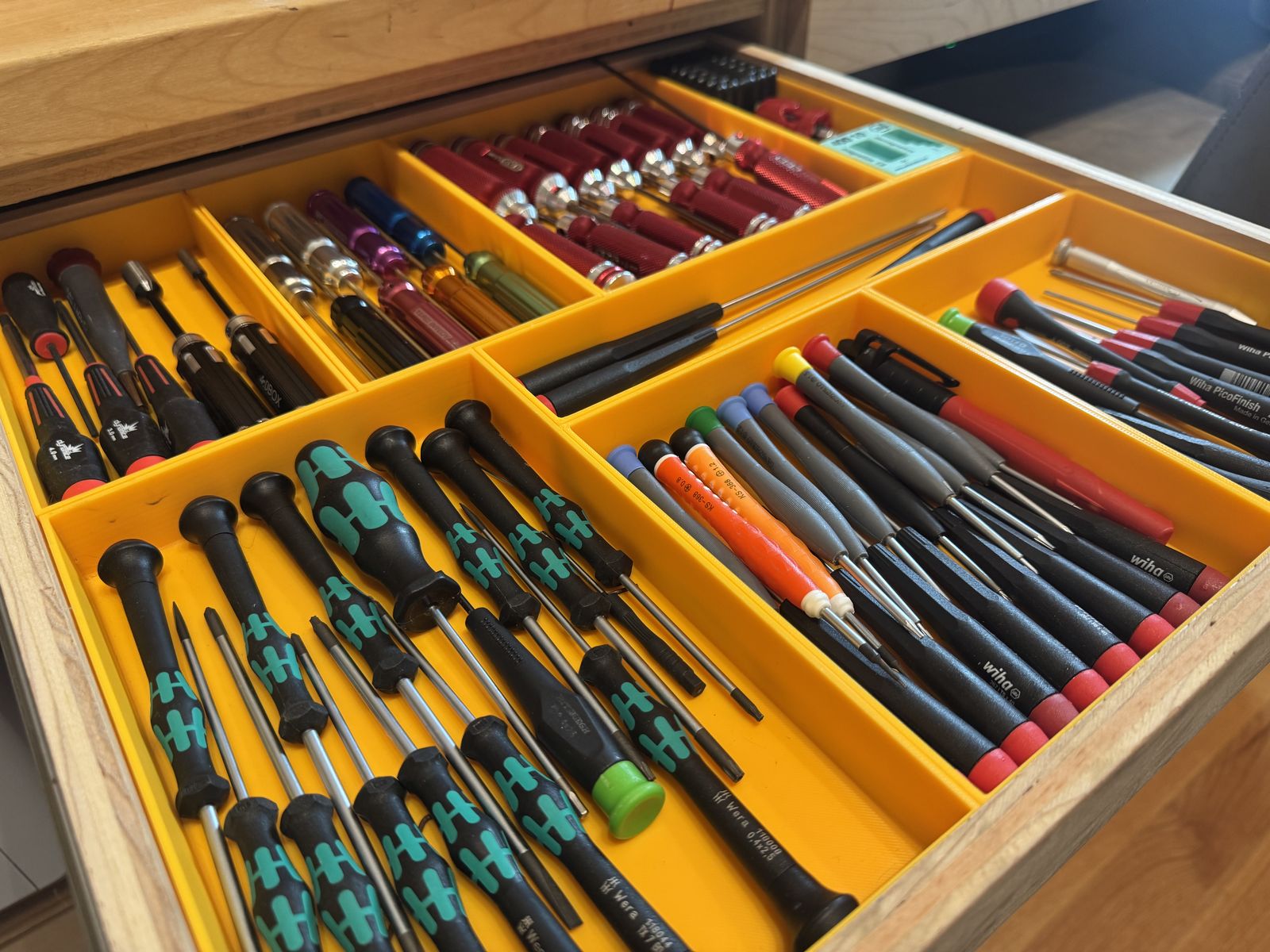
What an adjustable drawer organizer layout looks like
Flexible does not mean loose. The outside of the organizer is still made to the drawer: its inside width, depth, and height, plus whatever is in the way, like slides, rails, rounded corners, or a cutout for plumbing. That is what stops the organizer from sliding around and what uses the whole drawer.
The flexibility comes from the inside layout:
- Zones sized for categories. One tray for cooking tools, one for measuring tools, one for openers and small gadgets. Each one is sized for the group, with some room to spare.
- Compartment depth that matches the items. Long, narrow lanes for utensils, cables, or brushes. Wider, shallower trays for small loose things.
- A little extra room in each zone. Enough that a replacement item that is a bit bigger still fits.
- Several pieces that sit edge to edge. In a larger drawer, separate organizers that fit together can be lifted out or rearranged without starting over. Our larger designs are made this way.
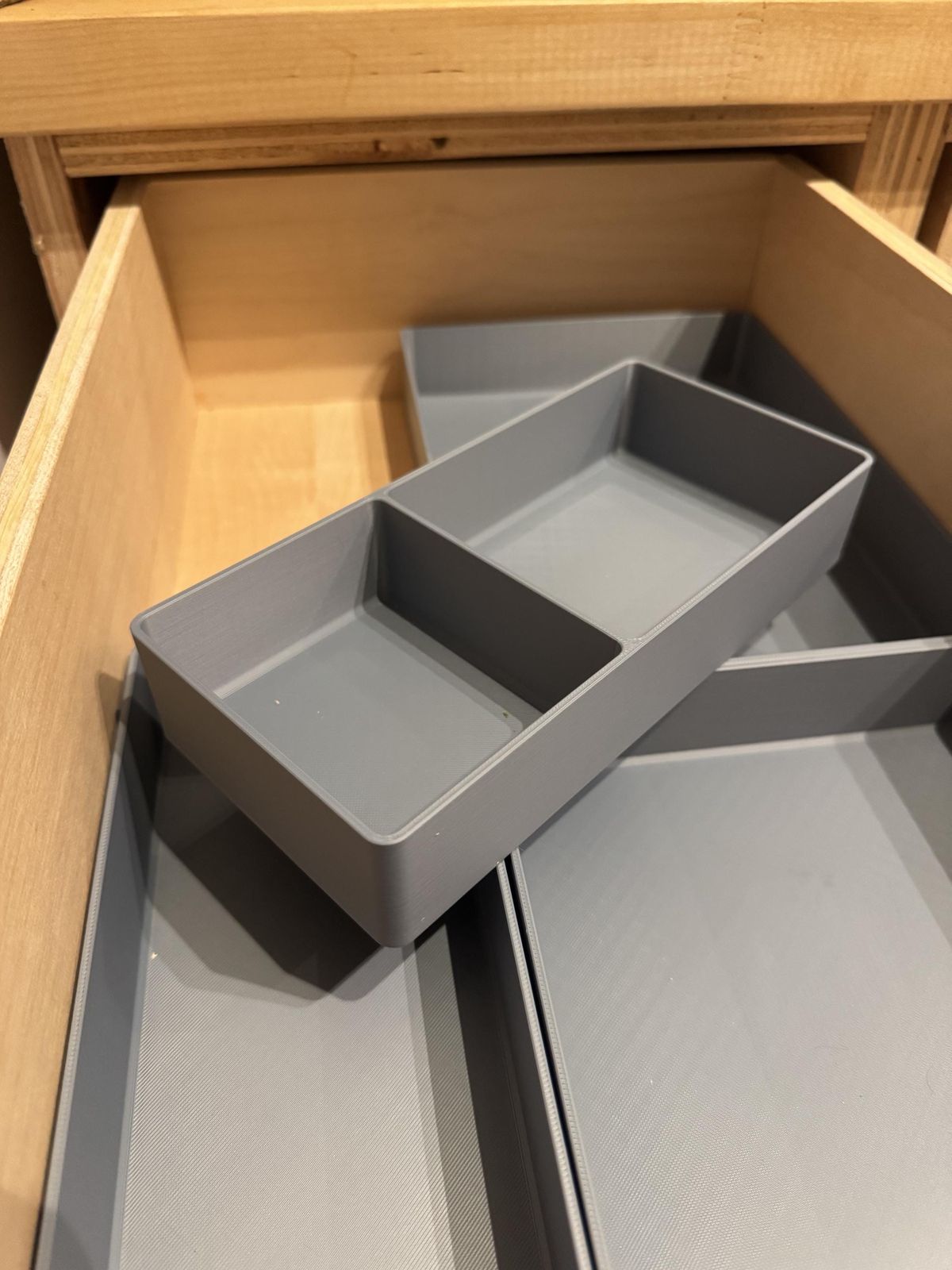
The result is a drawer that is tidy on day one and still works when the contents change.
How to plan zones for your own drawer
You can use this approach with any organizer, custom or not.
- Empty and reduce first. Keep what you actually use. (Our post on decluttering before organizing covers this.)
- Sort into groups by job. Four to six groups is plenty for most drawers.
- Measure each group roughly. Lay the items out and see how much floor they need. Add some room.
- Note the tallest item in each group. That decides compartment height and whether things can stand upright.
- Put daily groups at the front.
- Measure the drawer at the bottom, including anything that sticks into the space.
If you decide to order a custom layout, those four to six groups are all we need to size the trays. When you send a request to Acorn Custom, sharing what goes in the drawer is optional, but a note like "precision drivers by size, plus two long-shaft drivers" or "daily cooking tools up front, measuring cups in back" lets us plan multi-tray zones without locking you into single-item cutouts.
The payoff
A drawer organizer should outlast what you put in it. Exact cutouts are tied to one moment in time. Zones sized for groups of things keep working through new utensils, new makeup, and new cables, and the drawer stays organized without a redo.
If you're weighing custom vs. store-bought options, read are custom drawer organizers worth it. If your drawer is an odd size or has something in the way, see our custom drawer organizers or start a free design request to see a multi-tray zone plan for your space before you pay.
FAQ
What is an adjustable drawer organizer?
An organizer whose layout is built from larger zones or separate pieces sized for groups of items, so it still works when individual items change.
Are modular drawer organizers better than fixed dividers?
For most kitchen, bathroom, desk and junk drawers, yes, because zones handle replacements and new items. Fixed single-item slots suit sets that never change or tool kits where you need to spot a missing item.
How do you plan a drawer organizer layout?
Reduce first, sort items into four to six groups, measure how much floor and height each group needs, put daily groups at the front, and measure the drawer at the bottom.
Can a custom drawer organizer be rearranged?
In larger drawers, Acorn Custom makes several separate organizers that sit edge to edge, so pieces can be lifted out or moved.