
How to Organize Drawers: Declutter First, Then Place, Then Organize
Published Oct 16, 2026 · Updated Oct 23, 2026
How do you organize drawers step by step?
Empty the drawer, get rid of or rehome what you don't use, group what's left by job, test a layout with boxes you already have, then measure the inside and choose organizers that fill the bottom.
If you're wondering how to organize drawers so they stay that way, the answer is mostly about order. Most drawer projects start in the wrong place. Something is overflowing, so the first move is to shop for a tray. The tray arrives, it holds about half of what was in the drawer, and the rest gets piled on top or pushed to the back. A month later the drawer looks the same, only now there is a tray in it.
People who organize a lot tend to agree on the fix, and it is mostly about order. Reduce first. Decide where things live second. Buy organizers last. Here is how that works in practice.
Step 1: Reduce
Take everything out of the drawer. All of it, onto a counter or a towel on the floor. You cannot judge a drawer while it is still full, because the stuff at the back never gets looked at.
Then sort it into four piles:
- Keep here. Things you use often and that belong in this room.
- Keep, but somewhere else. The screwdriver in the kitchen drawer that really belongs with the tools. The spare phone charger that should live by the bed.
- Donate or give away. Duplicates in good shape, gadgets you have not touched in a year, the third vegetable peeler.
- Toss or recycle. Dried-out pens, dead batteries, takeout menus, cables for devices you no longer own.
A few rules make this faster:
- Duplicates are the easiest win. Most utensil and junk drawers hold two or three of the same thing. Keep the best one, or two if you really use two at once.
- "Someday" is a decision too. If you are not sure, put the item in a box with today's date. If you have not opened the box in a few months, you have your answer.
- Packaging takes room. Small items stored in their original boxes or blister packs take far more space than the items themselves.
This step is the one that changes how the drawer feels day to day. In decluttering communities a common warning is that containers bought early tend to get filled, and that a full container makes it harder to let things go. One r/declutter thread puts it simply: measure, figure out what you need, then look for containers (source). The KonMari crowd says the same thing (source).
Step 2: Place
Now look at what is left and decide where each group lives. This is about the whole room, not just one drawer.
- Put things where you use them. Spatulas near the stove. Tape and scissors near where you wrap packages. Hair ties near the mirror.
- Front for daily, back for weekly. The drawer front is prime space. Save it for what your hand reaches for most.
- Group by job, not by shape. "Things for opening packages" is easier to remember than "small metal things."
- Leave a little room. A drawer packed to the edge works on day one and fails as soon as you buy one new thing.
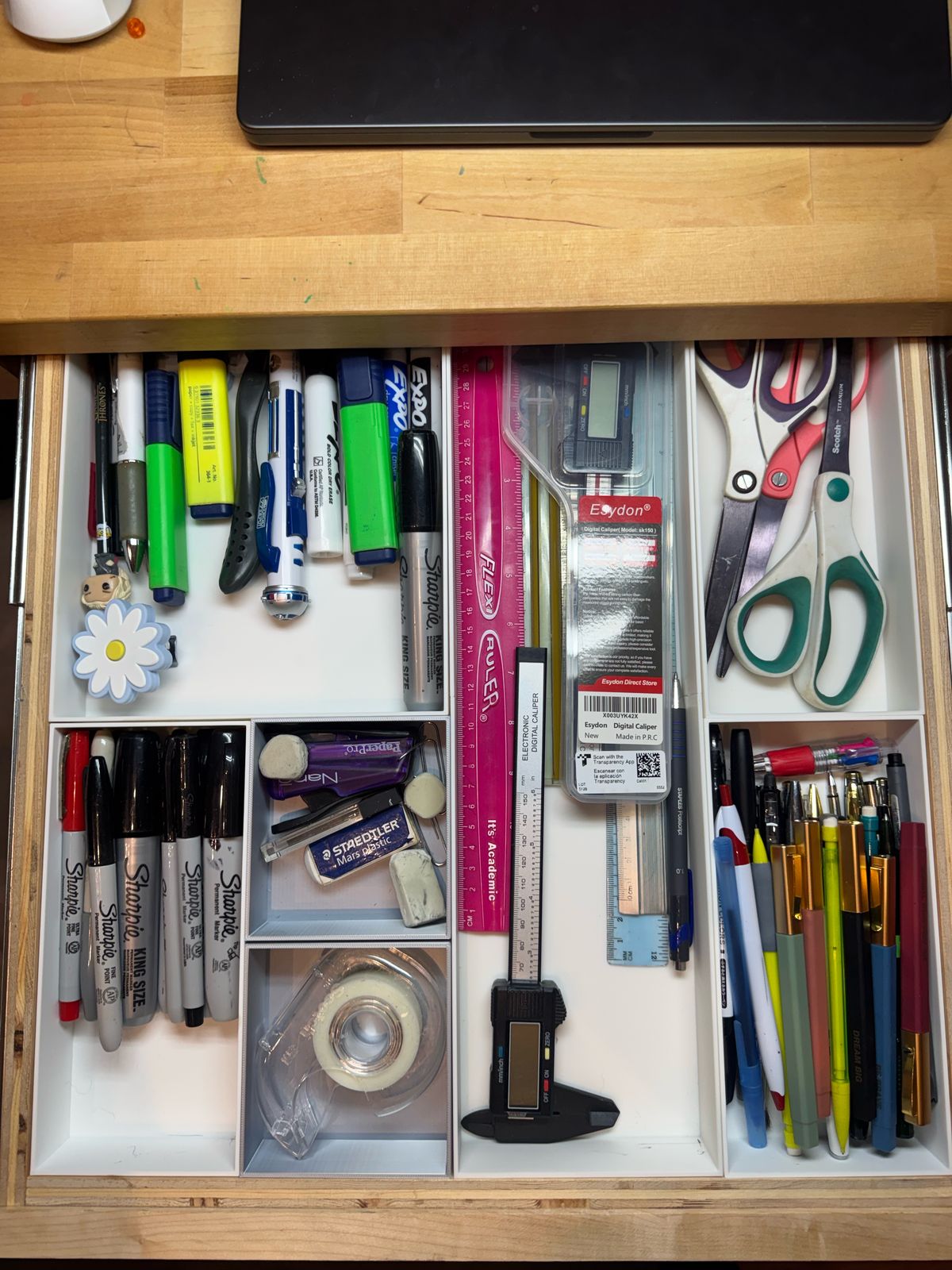
Try the layout before you buy anything. Use what you already have: shoe box lids, small boxes, mugs, even folded paper to mark zones. Live with it for a week. You will notice quickly that one zone is too small, or that something you thought you used daily has not moved.
This is also when you learn the real shape of the drawer. Some drawers taper, have a lip at the front, or have slides that stick into the space. Measure the inside at the bottom, not at the top edge, and don't forget the height. A tray can match the width and length perfectly and still stop the drawer from closing (source).
Step 3: Organize drawers with organizers that fit
Only now is it time to buy, build, or order organizers. You know three things you did not know at the start:
- What is staying, so you are buying for real items, not for the pile you started with.
- How much space each group needs, because you tested it.
- The actual inside measurements of the drawer, including anything that gets in the way.
With that in hand, picking organizers gets much easier. A few things to look for:
- Fill the footprint. Organizers that leave gaps slide every time the drawer opens. Pieces that cover the bottom edge to edge brace each other and stay put.
- Match the height. Shallow drawers need low trays. Deep drawers can hold taller compartments or items stored upright.
- Size zones for groups, not single items (more on this in why adjustable drawer organizers beat single-item slots). A zone for "measuring tools" will still work after you replace a measuring cup. A slot shaped for one exact cup will not.
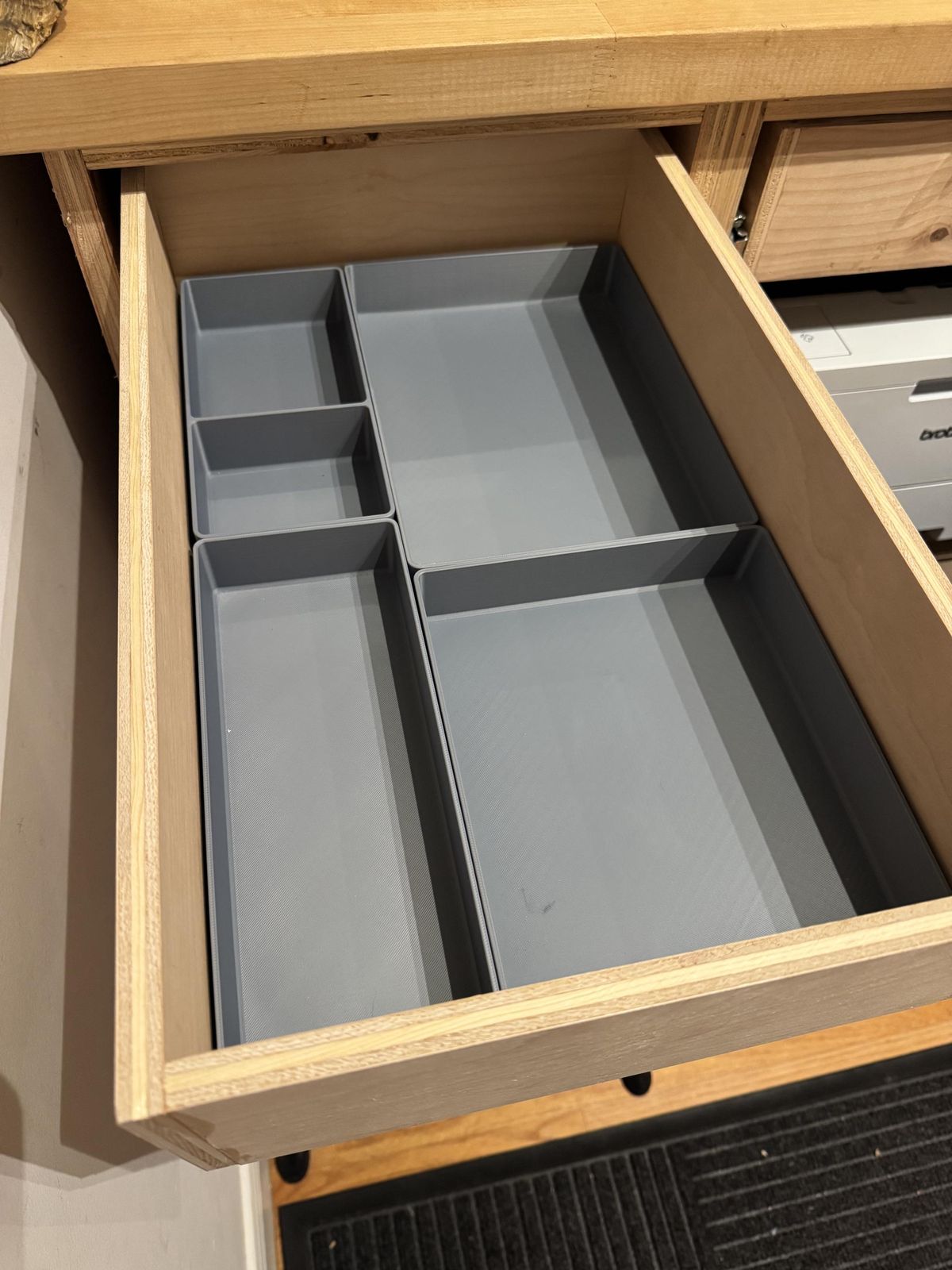
If the drawer is a standard size and your items are standard, a store-bought tray may be all you need. When the drawer has an odd footprint or needs a mix of long tool bays and small supply cups, like the five-tray wooden drawer above, custom drawer organizers let you match both the floor dimensions and the groups you sorted in Step 2. For cables and odds and ends, see the trick to junk drawers, or check our how it works page to see how we turn three measurements and a few phone photos into a layout proof.
Keeping it that way
Organized drawers drift. A few small habits help:
- One in, one out for categories that tend to grow, like cables, pens, and gadgets.
- A quick reset every few months. Take out anything that does not belong and put it where it does.
- Keep one small spot open as the landing zone for odd items, so they do not spill into every other zone.
The short version
Reduce, then place, then organize. The first two steps cost nothing and do most of the work. The third step goes faster and costs less once you know exactly what you are storing and exactly how much room you have.
FAQ
How do you organize drawers step by step?
Empty the drawer, get rid of or rehome what you don't use, group what's left by job, test a layout with boxes you already have, then measure the inside and choose organizers that fill the bottom.
Should you declutter before buying drawer organizers?
Yes. Buying organizers first means buying for items you may not keep. Declutter and test a layout first so you know how much space each group needs.
How do I measure a drawer for an organizer?
Measure the usable inside width, depth and height at the bottom of the drawer, and note anything that sticks into the space, like slides, a front lip or tapered sides.
How do I keep drawers organized?
Use one in, one out for categories that grow, do a quick reset every few months, and keep one small open spot for new items.