
How to Organize a Junk Drawer (and Your Cable Drawer)
Published Oct 16, 2026 · Updated Oct 23, 2026
What is the best way to organize a junk drawer?
Empty it, toss and rehome what doesn't belong, sort what's left into a few broad groups by job, and give each group a fixed spot with the most-used items at the front.
Here's how to organize a junk drawer, plus the cable drawer next to it. Almost every house has one. A drawer near the kitchen or the front door that holds keys to unknown locks, rubber bands, batteries of uncertain charge, a tape measure, takeout chopsticks, and a nest of cables. Often there is a second drawer that is just cables.
The trick is not a special product. A junk drawer is a drawer with no categories. Give it categories, give each category a fixed place, and it stops being junk.
Why these drawers get bad
Junk drawers collect small things that don't have a home anywhere else. Each item is small, so it never feels worth finding a real spot for. Over time the drawer fills up, things sink to the bottom, and nobody can find the scissors, so someone buys another pair. That pair goes in the drawer too.
Cable drawers have their own version of this. People keep every cable "just in case," and after a few years no one remembers which cable fits which device. One r/organization commenter described the cycle well: dump every cable into a box, realize you don't know what most of them are for, throw them out, then need one a week later (source).
Step 1: Empty and cut down
Take everything out. (The same reduce-first approach from how to organize drawers applies here.) Then:
- Toss the obvious stuff. Dead batteries (recycle them properly), dried-out pens, broken bits, expired coupons.
- Rehome what belongs elsewhere. Tools go with the tools, spare keys go on a hook or in a labeled envelope, medicine goes with the medicine.
- Cut cables to a working set. Keep cables for devices you own now, plus a spare or two of the common types you use most. Several people in a UK thread on this exact problem landed on the same rule: keep a few of the best ones of each type and let the rest go (source).
- Label the mystery cables. If you can't tell what a cable is for, put a small tag on it with today's date. If it is still a mystery the next time you clean out the drawer, it goes.
Step 2: Group by job
Sort what is left into a few groups based on what you do with them. For a junk drawer, common groups are:
- Writing: pens, markers, a pencil, a small notepad
- Fixing: a small screwdriver, tape measure, picture hooks
- Opening and closing: scissors, tape, rubber bands, clips
- Power: batteries and maybe a flashlight
- Keys and small hardware
For a cable drawer, group by connector or use:
- Phone and tablet cables
- Wall plugs and charging bricks
- Computer and display cables
- Audio and small adapters
- Spares
Keep the groups few and broad. Five good groups beat fifteen tiny ones, because a broad group still works when you add or replace something.
Step 3: Tame the cables before they go in
Loose cables tangle no matter what they sit in. Before a cable goes back in the drawer:
- Coil it in a loop or fold it in an S shape.
- Tie it with a reusable hook-and-loop strap or a twist tie.
- Label it if it is not obvious, either on the cable or on its zone.
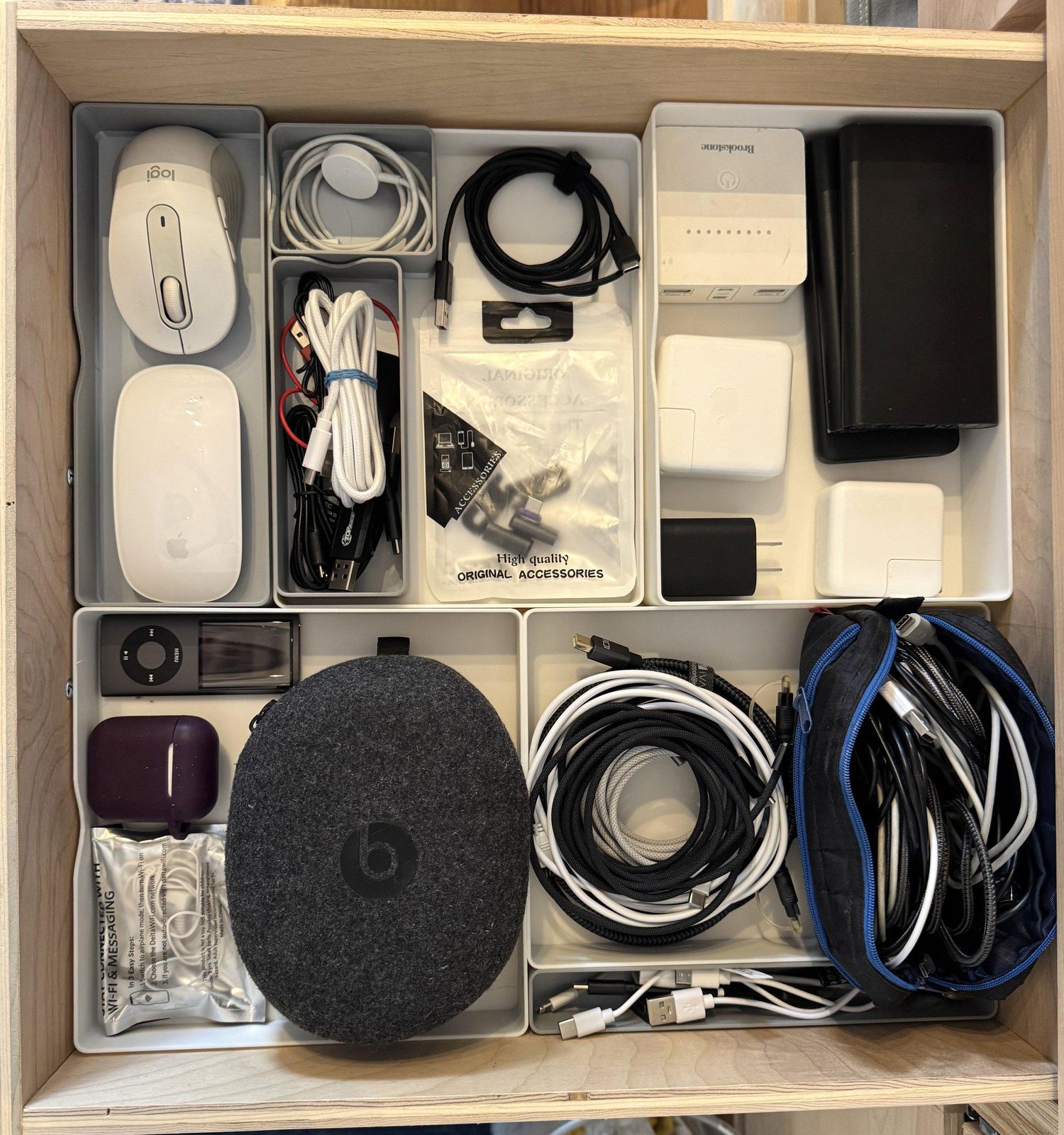
Some people bag each type in its own small labeled bag. Others stand coiled cables upright in a compartment so they can see every one at a glance. One person on r/OrganizationPorn reused an old kitchen utensil tray for cables and a shallow tray for plugs, so they could reach in and grab what they needed (source). That works because a utensil tray has long compartments, and long compartments suit coiled cables.
Step 4: How to organize a junk drawer with fixed zones
This is the real trick. Every group gets its own space in the drawer, and that space doesn't change. When the scissors always go in the front left, everyone in the house learns to look there and put them back there.
A few guidelines for the layout:
- Most used at the front. Pens and scissors usually win in a junk drawer. In a cable drawer it is the phone cable.
- Size zones for the group, not for one item. A compartment big enough for "writing things" handles a new marker without a problem. A slot cut for one specific pen does not. That's the idea behind an adjustable drawer organizer.
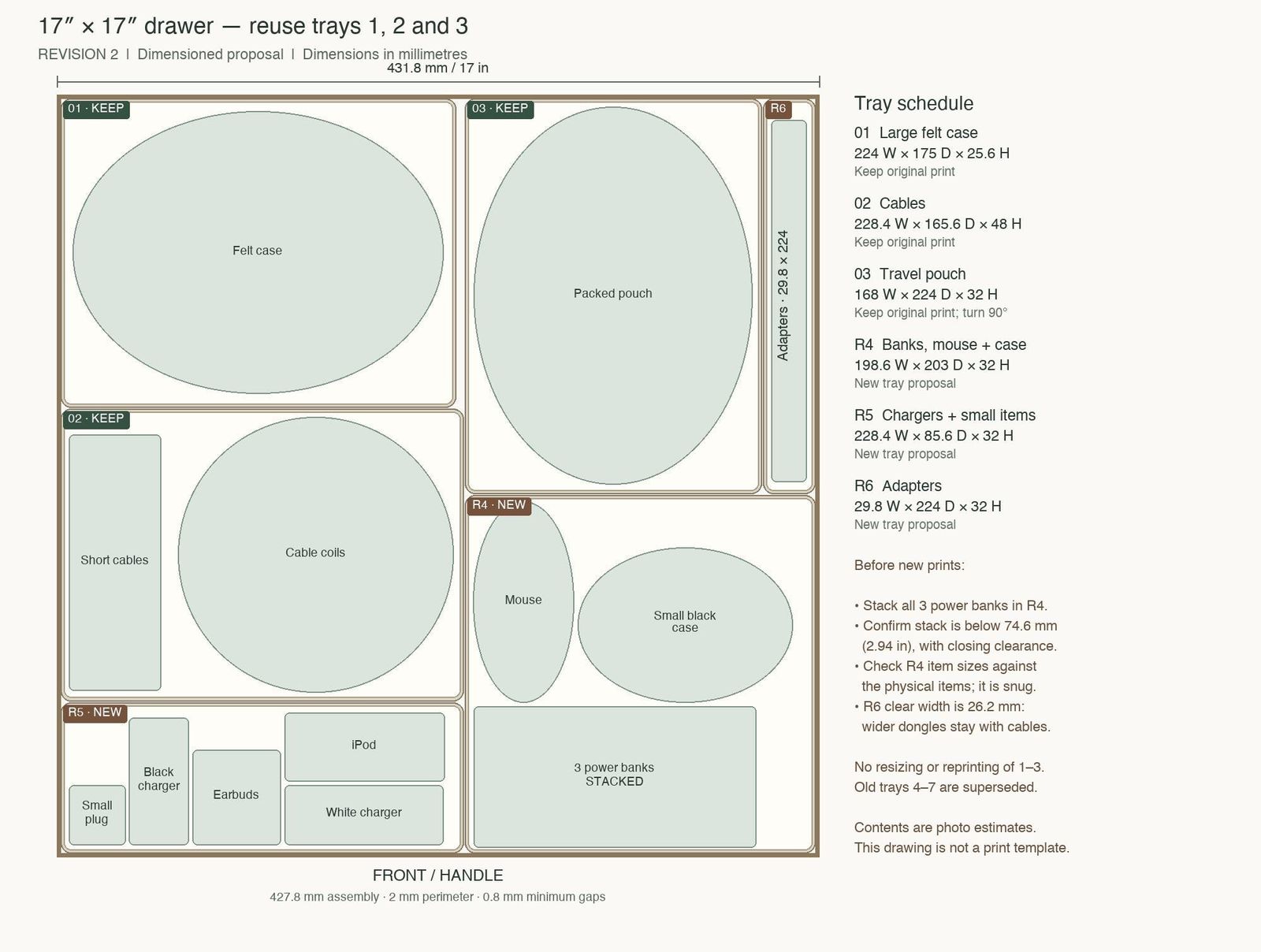
- Cover the whole drawer bottom. Trays that leave gaps slide around every time the drawer opens, and small things fall into the gaps. Pieces that fill the drawer edge to edge hold each other in place.
- Keep one open spot for things that just came in and don't have a home yet. Without it, new items get dropped wherever there is room, and the zones blur.
Step 5: Pick the container last
Once you know your groups and how much room each needs, choose the organizer. For many drawers, a mix of what you already have works fine: small boxes, an old utensil tray, a few bags for spare cables.
Store-bought trays struggle when you have bulky items next to tiny ones, or when you already own a few bins you want to keep using. In the 17 by 17 inch desk drawer plan above, the owner kept three existing trays for a headphone case, coiled cables, and a travel pouch, and we designed three new custom drawer organizers to fill the remaining floor down to a narrow 29.8 mm bay for dongles and adapters (see are custom drawer organizers worth it).
Keeping it working
- Quick reset each season. Pull out anything that wandered in and doesn't fit a zone.
- One in, one out for cables. New phone, new cable, old cable goes.
- Don't let the open spot grow. If it fills up, that is the sign to give those things a real home.
A junk drawer will always attract odd things. With a few broad groups, fixed zones, and one spot for strays, it can still be the drawer where you find the scissors on the first try.
FAQ
What is the best way to organize a junk drawer?
Empty it, toss and rehome what doesn't belong, sort what's left into a few broad groups by job, and give each group a fixed spot with the most-used items at the front.
How do you organize cables in a drawer?
Keep only cables for devices you own plus a spare or two, coil and tie each one, label the unclear ones, and store them by type in long compartments or labeled bags.
What should go in a junk drawer?
Small everyday things with no better home, like pens, scissors, tape, batteries, a tape measure and spare keys. Tools, medicine and spare chargers usually belong elsewhere.
How do I stop junk drawer organizers from sliding?
Cover the whole drawer bottom so trays brace each other. Grippy liner or museum putty under the corners also helps.