
Best Silverware Organizer for Deep Drawers
Published Oct 21, 2026 · Updated Oct 23, 2026
What is the best silverware organizer for a deep drawer?
The short answer: the best silverware organizer for deep drawers is one that uses the height, not just the floor. A standard cutlery tray is low, so in a deep drawer it leaves a band of empty space above the forks and spoons. You can live with that, add a second layer, choose taller compartments, or get an insert sized to the drawer. Which one is right depends on how deep the drawer is, how wide it is, and what else you want in it.
Why deep drawers are hard to organize
Most silverware trays are built for a standard top kitchen drawer. Many sit around 2 inches tall, which is plenty for a fork lying flat. Put that same tray in a deep drawer and the bottom fills while everything above it stays empty, or turns into a pile of loose ladles and spatulas on top of the tray.
Deep drawers also tend to be the ones that aren't standard widths. Expandable trays cover a range, and a drawer just outside that range ends up with a gap at one end or a tray that won't sit flat. If you're starting from a crowded drawer, clear it first with the steps in how to organize drawers, then decide what really needs to live there.
Comparing the best silverware organizer for deep drawers
| Option | Uses the height? | Best for | Watch out for |
|---|---|---|---|
| One standard tray | No | Tight budgets, drawers you can't reuse | Wasted space, clutter piling on top |
| Two layers | Yes | Big sets, holiday and serving pieces | Reaching the bottom layer, drawer clearance |
| Tray with taller compartments | Partly | Mixed silverware and small tools | Fixed sizes that may not match your drawer |
| Made-to-measure insert | Yes | Odd widths, deep and narrow drawers | Wait time, higher cost than a tray |
| Move silverware elsewhere | Not needed | Kitchens with a free shallow drawer | Losing a deep drawer to small items |
One standard tray
This is the cheapest and fastest choice, and it's honestly fine if the tray fills the floor and you don't mind the space above. It works best when nothing else needs to go in the drawer.
Two layers
A second layer turns the empty height into storage. Put everyday forks, knives and spoons on top where you reach them most, and keep serving pieces, the good set or rarely used utensils underneath. Measure the usable height first, with the drawer open, from the floor to the lowest thing the organizer would hit when it closes. Both layers have to fit under that number.
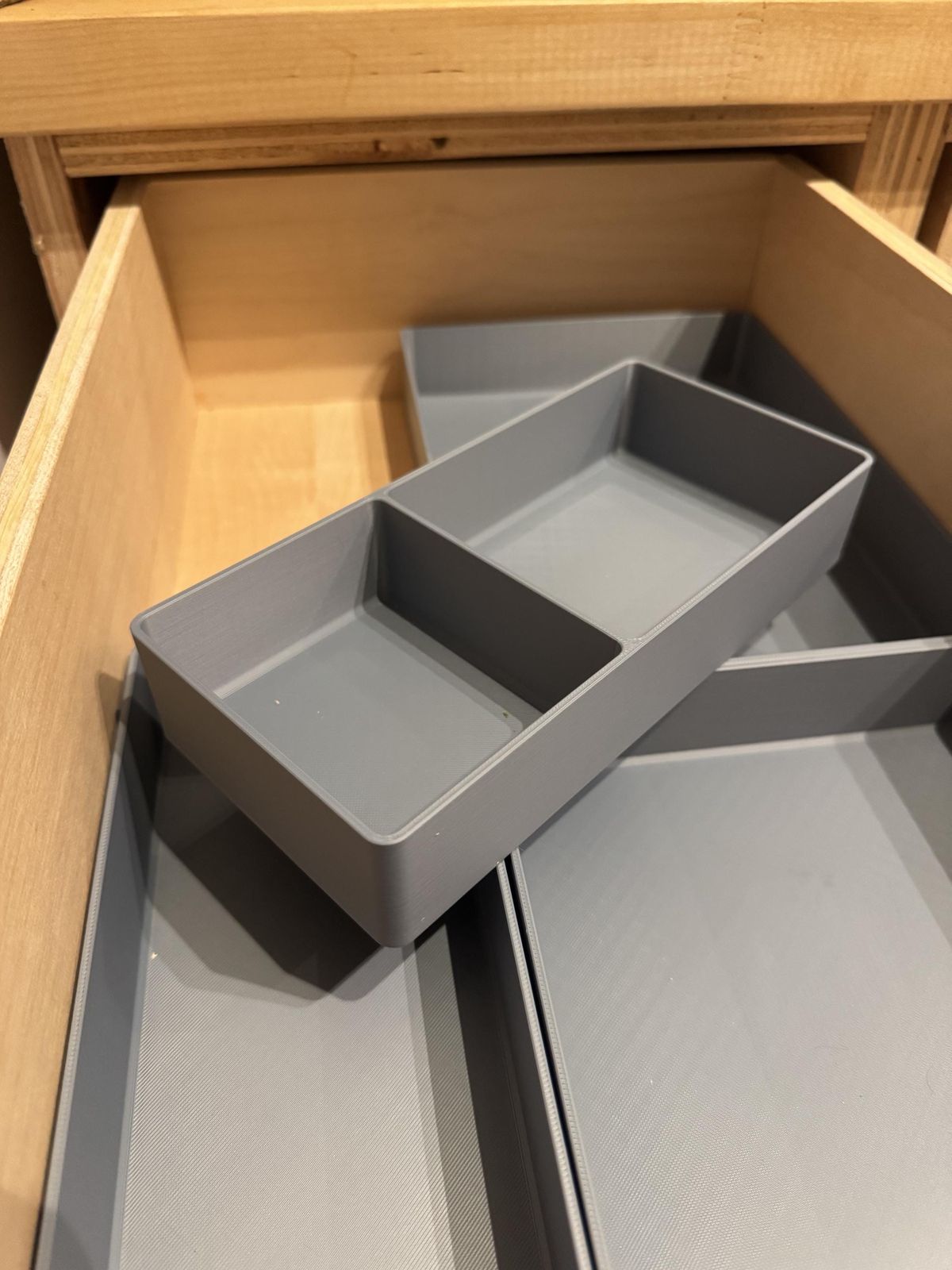
Taller compartments
Some trays and modular kits for deep drawers have higher walls, which keeps items from spilling over and gives room for a few taller tools. The limit is that the compartment sizes are fixed by the maker, not by your drawer, so check the width and depth against yours.
A made-to-measure insert
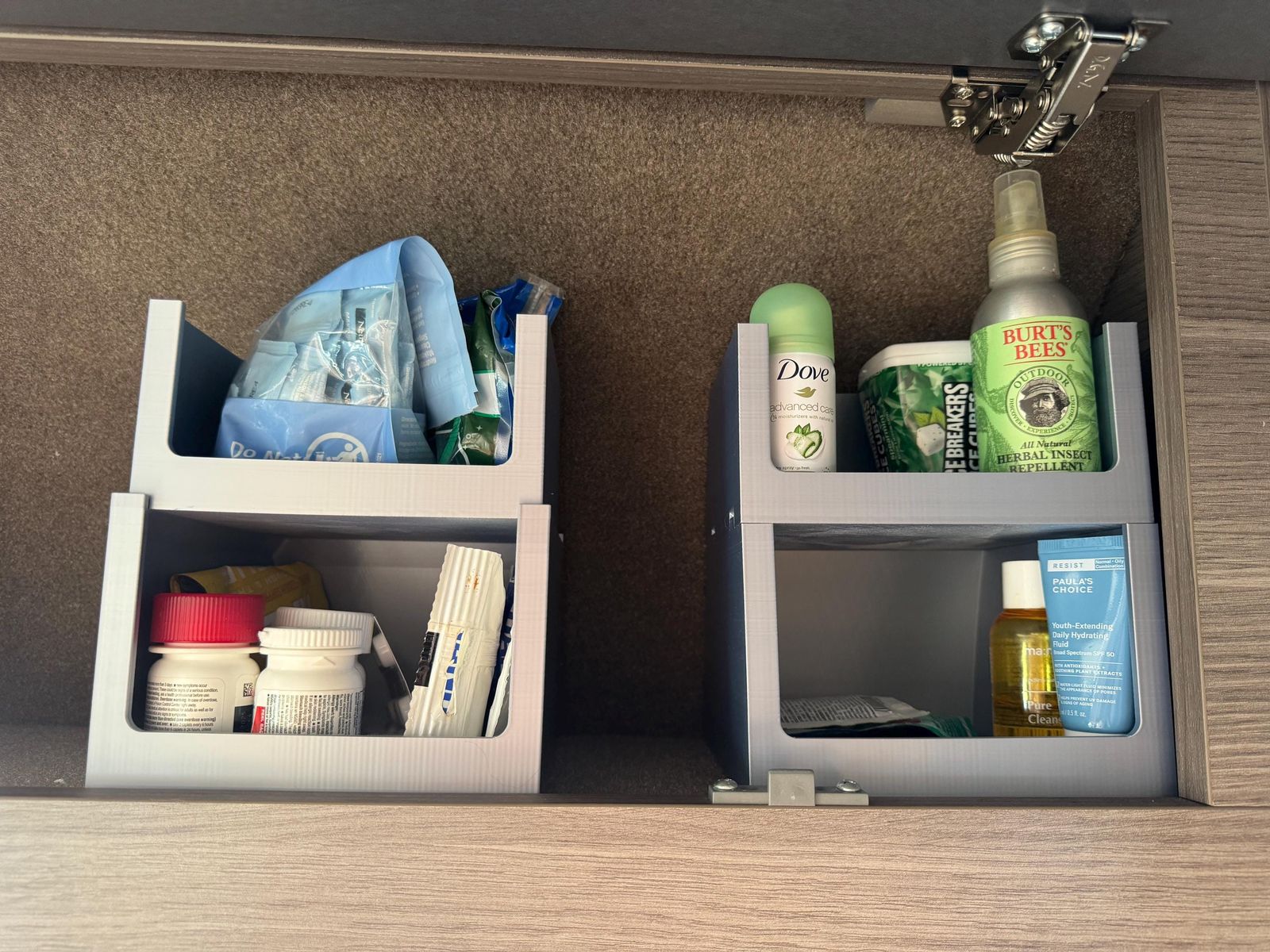
When the drawer is wider or narrower than expandable trays cover, or deep enough that a single layer wastes most of it, a fitted insert can fill the footprint edge to edge and use the height you have. Group compartments by what goes in them, not by single items, so the layout still works when your set changes. The adjustable drawer organizer post explains that approach.
Move the silverware
Sometimes the best silverware organizer for deep drawers is no organizer at all. If a shallow drawer nearby is free, silverware may be happier there, and the deep drawer can hold pots, containers or bulky tools.
How to choose in four steps
- Measure three things: usable inside width, depth and height. Take width and depth at the narrowest points.
- Count what goes in: daily silverware, serving pieces, steak knives, small tools. That tells you whether one layer is enough.
- Check the range: if an expandable tray covers your width and you only need one layer, try it first.
- Go custom when the tray leaves a gap you can't close or wastes height you need, as our custom vs. store-bought page lays out.
When store-bought is the better choice
Buy a tray when the drawer is a common size, the tray fills it well, your set is standard, or you need it this week. It costs less and you can test a layout before committing. Our custom drawer organizer vs store-bought inserts post goes through the trade-offs in more detail.
When a custom silverware organizer makes sense
When you want to use a deep drawer's vertical clearance without losing half the floor to an awkward width, we design custom drawer organizers around your usable inside width, depth and height. You can ask for taller walls, a lift-out top tray over a lower tray, or separate pieces that brace edge to edge across a wide drawer. See how it works for the measurement steps.
For a busy silverware drawer, our materials page recommends PETG because it is tougher and more impact resistant than PLA. Organizers are great for forks, spoons and kitchen tools, though they are not for direct contact with unpackaged food and must be hand-washed with mild soap and cool or lukewarm water rather than placed in the dishwasher.
Still deciding whether custom is worth it for this drawer? Read are custom drawer organizers worth it, or start a free design request to see a proof and price before you pay anything.
FAQ
What is the best silverware organizer for a deep drawer?
One that uses the drawer's height as well as its floor. That can be a low tray plus a second layer, a tray with taller compartments, or a made-to-measure insert sized to the usable height. If a standard tray fills the floor and you don't mind the empty space above it, that is the cheapest choice.
Can you stack two silverware trays in a deep drawer?
Yes, if the drawer has the height for both and you can still reach the bottom layer. Keep everyday forks, knives and spoons on top and less-used pieces like serving sets underneath, and check that the drawer closes with both layers in.
What if my drawer is wider than an expandable silverware tray?
An expandable tray only fits drawers inside its range, so outside it you get gaps at the ends or a tray that won't go in. You can fill a small gap with a second narrow piece, or use an organizer made to your drawer's width.
Can a 3D printed silverware organizer go in the dishwasher?
Not ours. Acorn Custom organizers should be hand-cleaned with mild soap and cool or lukewarm water, and kept out of the dishwasher, microwave and oven. They are fine for utensils and kitchen tools.